Monday, August 25, 2014

Orpheus

Mosaic Floor with Medusa, Roman, CE 115-150. The Getty Museum.

Ovid with Laurel symbol of a great poet

Dante

Trees always save the day. As you probably know by now, at the end of the story Daphne's father Peneus decides the best way to save his daughter from love-crazy Apollo is to transform her into a laurel tree. (We're not quite sure what his reasoning is on this one, but apparently it made sense to the ancient Greeks.)
Apollo feels like crap about how it all went down, so he "honors" Daphne by making the laurel his sacred tree. He also gives the tree some of his own eternal youth to make it an evergreen. So, even though Daphne is the one who turns into the tree, the laurel ends up being a symbol of Apollo himself. The god is often depicted in art as wearing a wreath of laurel, and his lyre and bow are usually decorated with laurel leaves. (Don't believe us? Check out some pictures here.)
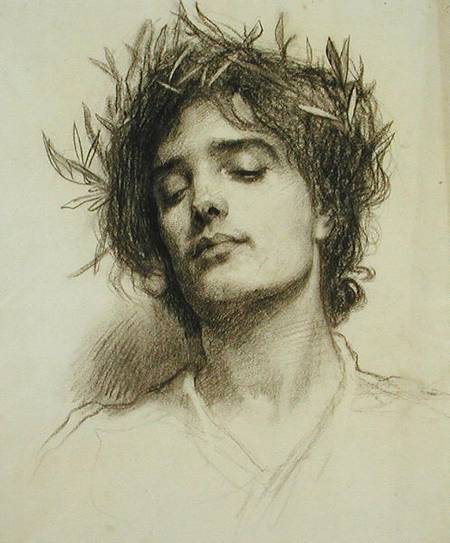
Because the laurel was considered sacred to Apollo, wreaths of its leaves were used to decorate the winners of the Pythian Games, which were held in honor of Apollo at Delphi. It was kind of like being awarded a gold medal. Using laurel wreaths as badges of honor spread from there to the Olympic Games, and the practice was eventually picked up by the Romans. You've probably seen a picture of some random Roman or Italian dude with leaves wrapped around his head, right? (Don't know what we're talking about? Check out the great poets Danteand Ovid.) Well, those are probably laurel leaves; they were used to honor someone after a victory or great accomplishment of some kind.
(Actually, we made that sound a lot simpler than it really is. The Romans were rather obsessed with wreaths of various leaves, and each type of wreath meant something different. We're talking about the "corona triumphalis," made of laurels and used to indicate a triumph. If you want to know more about the other types of wreaths, click here.)
Have you ever heard someone say, "Don't rest on your laurels" when warning another person not to get too cocky after a big win? Well, now you know where that comes from – the phrase references none other than the laurel wreaths that were awarded for a victory. It's kind of weird that what started out as a symbol of Apollo's defeat in love became a symbol of human victory.




Royalty-Free (RF) Laurel Wreath Clipart Illustration by BestVector - Stock Sample #1061915

inter-

model lima v2

HELMUT LANG PRE-FALL 2013

What's In Your Bag: How a Molecular Scientist Prepares for Field Work Tracie Seimon of the WCS Is Always Prepared

http://online.wsj.com/news/article_email/whats-in-your-bag-how-a-molecular-scientist-prepares-for-field-work-1408580941-lMyQjAxMTA0MDIwMDEyNDAyWj

Over the course of several research trips abroad, molecular biologist Dr. Tracie Seimon has mastered the art of packing up her mobile laboratory. This time, she's packing for a trip to Myanmar to check up on Burmese star tortoises.
Some people light incense in the shower to set a mood. Tracie Seimon uses it for protection: The smoke keeps the swarming mosquitoes at bay during the most vulnerable 15 minutes of her day.
As a molecular scientist with the Wildlife Conservation Society based at New York's Bronx Zoo, Dr. Seimon travels several times a year to tropical locations to test animals for diseases that could threaten a species.
In mid-September, she will be bringing her team to Bagan, Myanmar to examine a group of endangered Burmese star tortoises hatched in a breeding program. Each tortoise needs a clean bill of health before being released into the wild. In May, Dr. Seimon was in Uganda studying a fungus threatening world-wide frog populations.
When it comes to bug repellent, she insists on a DEET concentration of at least 30%. She dismisses any popular concerns about its toxicity. "I'm more worried about getting a tropical disease than I am about the long-term effects of DEET," Dr. Seimon says. (Malaria, yellow fever, dengue fever, West Nile virus and encephalitis are all mosquito-borne illnesses, according to the U.S. Centers for Disease Control and Prevention.)
Growing up in Colorado Springs, Colo., Dr. Seimon always knew she wanted to be a scientist working with animals. When her parents gave her a microscope at age 10, she spent days collecting pond scum. By high school, she was breeding aquarium fish out of five tanks in her bedroom.
Part of Tracie Seimon's mobile laboratory, which includes a heat block at top left and a centrifuge at top right Brian Harkin for The Wall Street Journal
She has been with the WCS since 2010, traveling with a mobile laboratory to do DNA testing of viruses and bacteria in animal cells. Her equipment includes a mini-centrifuge, a fluorometer, which measures how much DNA was recovered, a mini-freezer, and a supply of plastic tubes and rubber gloves, which all get packed into 24-gallon Rubbermaid ActionPacker cargo boxes.
For personal items, it's carry-on only. Dr. Seimon brings two long-sleeved safari-style shirts, a pair of Columbia travel pants made of mosquito-repellent fabric, a T-shirt and powdered laundry detergent.
Her trips usually involve nights in the field, so she brings her own bed mosquito net by Texsport. A mini-medical kit is essential: antibiotics, probiotics for stomach woes, Advil and Emergen-C, a powdered vitamin-supplement drink.
Her sparse toiletry kit holds little bottles of liquid soap, shampoo and Neutrogena sunscreen.
Also in her bag: clockwise from left, a treasured baseball hat, a sarong, mosquito netting, instant-coffee supplies, a travel-log book and a medical kit.
Dr. Seimon brings a wrap or sarong that does double duty as a coverup for outdoor bathing and, when tied at the waist and topped with a blouse, completes an outfit appropriate for dinner with local government officials.
Because the electricity can go out any time, she carries a Black Diamond headlamp, even to dinner.
Dr. Seimon takes along an iPhone, MacBook Pro and a Canon 60D camera. Her hobby is macrophotography, which involves taking extreme up-close photos, and she uses a Canon EF 100 mm macro lens to zoom in on nature. She keeps a travel log in an all-weather memo book by Rite in the Rain.
Her most-treasured item? It's a tossup between her WCS staff baseball cap, which she's wanted to wear since she was a child, and her emergency Starbucks kit.
"I'm kind of a coffee snob," Dr. Seimon says, holding a plastic bag full of Starbucks VIA instant coffee packets and small bottles of sugar and powdered milk. "I don't go anywhere without this."
—Hilary Potkewitz